
Are we any closer to cloning endangered species from stored tissues, gene editing to improve species’ resilience and using gene drives to suppress pest populations?

A new Royal Society Te Apārangi resource outlines how gene technologies could transform conservation over the next ten years, but there are still many scientific and ethical hurdles to go.
Professor Peter Dearden, a geneticist at the University of Otago and Fellow of the Royal Society Te Apārangi, who provided advice for the new resource, says genetic possibilities are real – but there is still a significant amount of science, regulation and public discussion to work through before they become a reality in New Zealand.
“There’s quite a lot of hype here about things that are going to be incredibly difficult,” he says.
“This is not an off-the-shelf technology.”
Gene drives for pest species
Much of the excitement surrounds gene drives, which are genetic systems designed to spread a particular trait through a population over successive generations. In theory, they could one day be used to suppress invasive pests such as rats, stoats or possums.
While modelling suggests the approach could eventually become an effective conservation tool, Peter says the technology is still in its infancy.
“Gene drives are only really effective in fruit flies and mosquitoes at the moment.”
The challenge is that gene drives work particularly well in fast-reproducing animals. Mammals, particularly larger ones such as possums, reproduce far more slowly.
Any edited gene would take a long time to spread through a population, Peter says.
Rats may ultimately prove to be more suitable candidates, but before any genetic technology could be considered, researchers first need a detailed understanding of the species they’re working with.
“All the background knowledge is required before you can do the fancy stuff.”

His own research programme on invasive wasps has focused on sequencing genomes and building that foundational knowledge. That work is particularly important in New Zealand, where many conservation challenges are unique.
Other countries don’t view possums and stoats as predators, he says, which means the groundwork to create these gene drives would need to be done in NZ.
“Nobody is going to come riding to our rescue.”
Gene editing for endangered wildlife
While genetic technologies often capture public attention for their potential to control pests, Peter says applying them to endangered species may prove even more difficult.
One possibility highlighted by the Royal Society is using gene editing to make threatened species more resilient to environmental pressures.
But knowing which genes to change, and being confident those changes won’t cause unintended consequences, remains a major scientific challenge.
“It sounds really good,” Peter says, “[but] if you say to me, ‘What gene edit would I make to make a takahē resistant to bird flu?’ My answer is: I don’t know.”
The difficulty is compounded by the fact that endangered species leave little room for error.
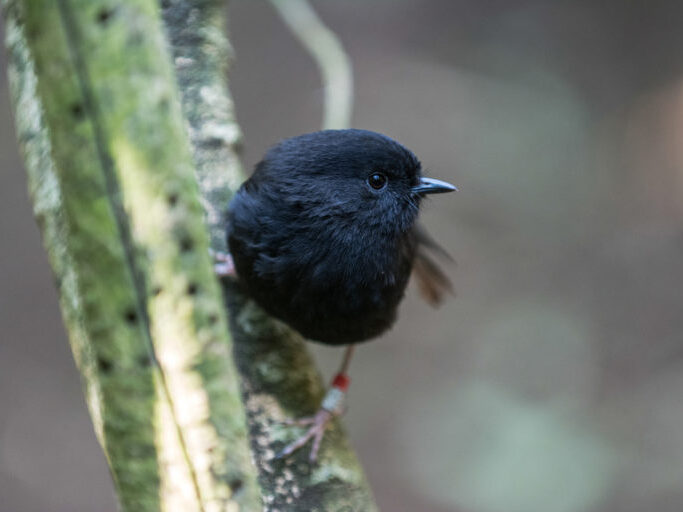
Peter says if he wanted to make an edit on a black robin, with only 300 birds remaining, he wouldn’t be able to do the testing required to ensure the edit wouldn’t have a negative effect.
“If every individual is precious, then every gene edit seems precious to me.”
By contrast, pest species can be studied in contained environments across multiple generations, allowing scientists to monitor for unintended mutations before any wider application is considered.
It involves more than biology
As well as scientific challenges, there are equally important ethical and social questions being asked about the technology.
In Aotearoa New Zealand, decisions about gene technologies involve more than biology. Questions of kaitiakitanga (PDF, 17.6 MB) and how genetically modified animals might move between areas that different iwi oversee all need to be considered.
“As scientists we have to be open to asking the question [of whether it’s ethical to do],” Peter says.
“And we have to be open to the fact that the answer might be no. The only way we can do that is if we ask people.”
The rules are changing
The regulatory framework for gene technology is also evolving.
The Gene Technology Bill currently before Parliament aims to modernise current legislation and provide a clearer process for assessing future research applications.
Peter says updating the legislation was important, but it should not be mistaken for a green light.
“There would [still] be large amounts of consultation, and I think that is probably a good thing.”
For now, New Zealand’s conservation efforts will continue to rely on proven tools such as trapping and poisoning, which Peter says remain highly effective.
Rather than replacing those methods, he sees gene technologies as a possible next generation of conservation tools – ones that may still be a decade away.
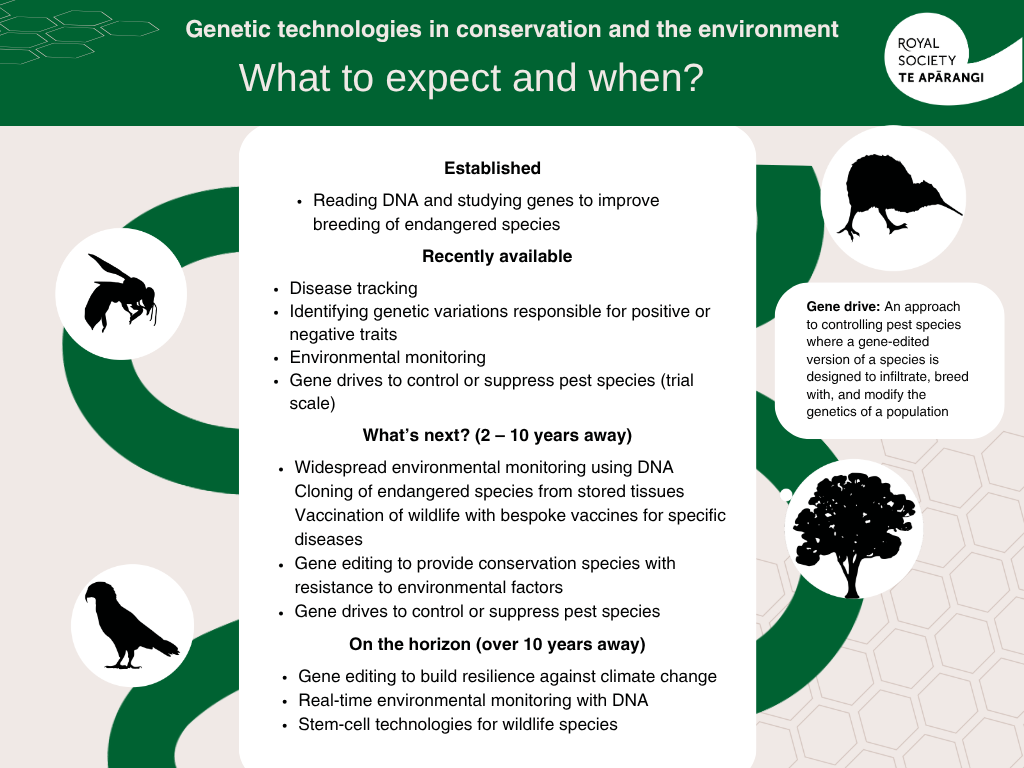
Peter wants to see the investment in gene technology now, so that when application becomes scientifically possible, they have the background knowledge needed to make informed decisions.